3 Best Beginner Exercises for Wider and More Muscular Pecs | BOXROX
A wider, more muscular chest can make your upper body look stronger, improve pressing performance, and help create a more balanced physique. Beginners often assume they need complicated cable combinations or heavy barbell training to build their pecs. In reality, a few well chosen movements, performed consistently and progressed over time, can deliver excellent results.
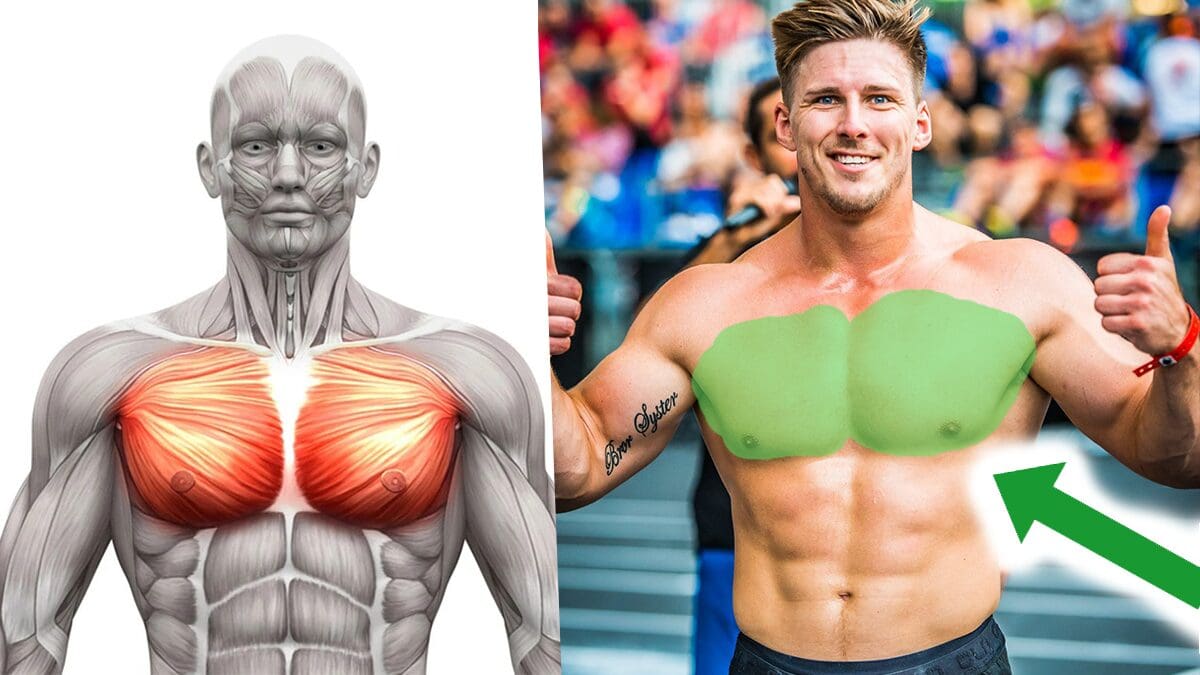
It is important to set realistic expectations. The width of your rib cage and the shape of your pectoral muscles are largely determined by genetics. You cannot change where the muscles attach to your sternum, collarbone, or upper arm. What you can do is increase the size of the pectoral muscles. As the chest develops, it can look fuller, denser, and visually broader from the front.


The pecs are primarily responsible for bringing the upper arm toward the body, moving it across the chest, and assisting with pressing movements. The major chest muscle has fibers that run in different directions, so a good beginner program should include a pressing exercise and a movement that allows you to actively bring the arms together. Resistance training builds muscle when it provides enough mechanical tension, sufficient hard sets, and gradual progression over time.
The following three exercises are beginner friendly, easy to progress, and highly effective for building a more muscular chest.
How to Build Bigger Pecs as a Beginner
Muscle growth is not about finding one magic exercise. It comes from repeating productive movements with good technique, gradually making them more challenging, and allowing your body to recover. Research consistently shows that resistance training can increase muscle size across a wide range of loads when sets are performed with enough effort. This means beginners do not need to lift maximal weights to build their pecs.
Start with two chest focused sessions each week. This gives you enough practice to improve your technique while leaving time for recovery. Aim to complete each set with one to three good repetitions left before failure. You should feel that you could continue if necessary, but your final repetitions should still feel demanding.
Are Bar Facing Burpees the Perfect Exercise for Burning Body Fat?
For each exercise, prioritize a controlled lowering phase, a full comfortable range of motion, and a stable body position. The goal is not simply to move weight from one point to another. The goal is to make the chest muscles do the work.
Exercise One: Incline Push Up
The incline push up is one of the best starting exercises for beginners because it allows you to learn the basic pressing pattern without needing to handle your full body weight. Place your hands on a sturdy bench, bar in a rack, countertop, or other stable raised surface. The higher the surface, the easier the exercise becomes.
Stand far enough back that your body forms a straight line from your head to your heels. Place your hands slightly wider than shoulder width, brace your stomach, and bend your elbows to lower your chest toward the surface. Press back up until your elbows are straight, while keeping your shoulders down and away from your ears.
Push ups train the chest, triceps, and front of the shoulders in a movement pattern that closely resembles the bench press. Research comparing push up training with bench press training has found that push ups can produce similar improvements in muscle size and strength when the difficulty is adjusted appropriately. For a beginner, that makes the incline variation a practical route to stronger and more developed pecs.
The key is choosing an incline that is challenging enough. If you can easily perform more than 20 repetitions with perfect form, lower the height of your hands. As you get stronger, move from a countertop to a bench, then to a lower support, and eventually to floor push ups.
Keep your elbows angled slightly toward your sides rather than flaring them directly outward. Lower with control until your chest comes close to the surface, then press strongly through your hands. This gives the chest a useful stretch at the bottom while keeping the movement stable and repeatable.
Start with two to three sets of eight to 15 repetitions. Once you can complete the top of the range with excellent control, make the exercise harder by lowering the incline.
Exercise Two: Dumbbell Bench Press
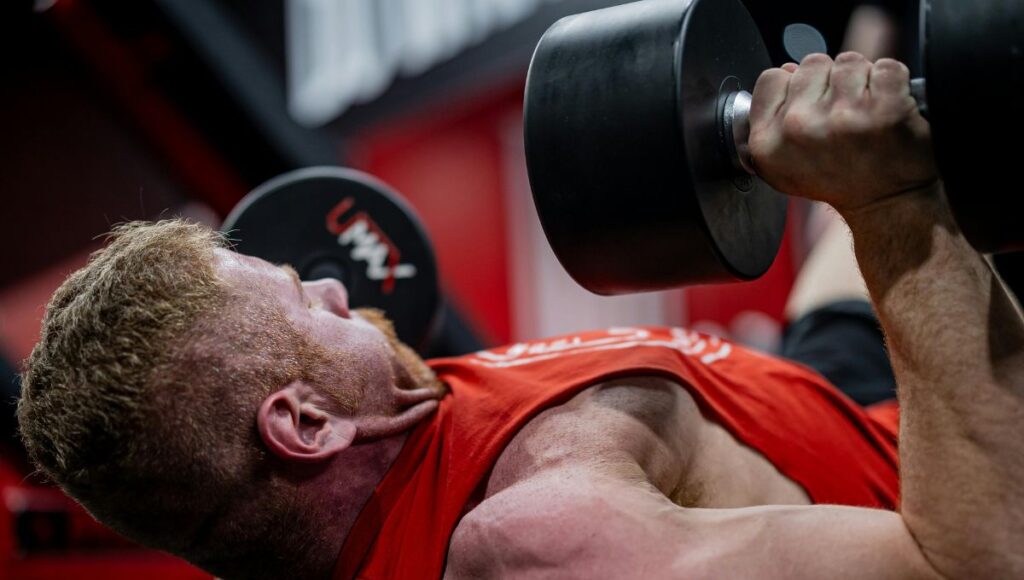
The dumbbell bench press is a powerful chest building movement because it lets each arm work independently. This can help beginners develop better control and avoid allowing one side of the body to dominate the other. Dumbbells also allow a natural arm path, which many people find more comfortable than a fixed barbell position.
Lie on a flat bench with a dumbbell in each hand. Begin with the weights above your chest and your feet firmly on the floor. Lower the dumbbells slowly until your upper arms are close to parallel with the floor and your elbows are bent at a comfortable depth. Press the weights back up by driving your upper arms toward the center of your chest.
Your grip can be slightly turned inward rather than completely pronated. This often feels more natural for the shoulders. Keep your shoulder blades gently pulled back against the bench and avoid allowing the weights to drift too far toward your shoulders. Think about lowering the dumbbells under control, then pressing them upward and slightly inward.
The dumbbell bench press places the pecs under tension through a large range of motion. Resistance training performed through a full comfortable range of motion generally produces greater muscle growth than training with partial repetitions alone. The bottom position also provides a loaded stretch for the chest, which is valuable for hypertrophy when it is controlled and appropriate for the lifter.
Do not worry about lifting heavy weights immediately. Choose dumbbells that let you complete eight to 12 controlled repetitions while maintaining the same technique from the first repetition to the last. When you can complete all your planned repetitions with confidence, increase the weight slightly.
Beginners should avoid dropping the dumbbells too deeply below the chest if the shoulders feel uncomfortable. A strong pec workout should challenge the muscles, but sharp pain, pinching, or instability are signs to stop and adjust the range of motion or seek qualified coaching.
Exercise Three: Cable Chest Fly
The cable chest fly gives beginners something that pressing exercises cannot provide as directly. It allows you to bring the upper arms toward the midline of the body under continuous tension. This movement closely matches one of the primary functions of the pectoral muscles.
Set the cable handles at roughly chest height. Stand in the middle of the machine with one foot slightly in front of the other for balance. Begin with your arms open at your sides and a soft bend in your elbows. Bring the handles together in front of your chest in a controlled arc, then slowly allow your arms to open again.
The most important coaching cue is to move from the shoulders rather than turning the exercise into a triceps extension. Your elbows should stay in nearly the same position throughout each repetition. Imagine that you are wrapping your arms around a large tree. This helps keep the tension on the chest rather than shifting it toward the arms.
Cable resistance remains present throughout the movement, including near the position where your hands meet. This can make the exercise especially useful after pressing, when the chest is already fatigued and you want additional high quality work without using extremely heavy loads.
Use a light weight at first. The chest fly is not an exercise to chase impressive numbers. Too much load usually causes the shoulders to roll forward, reduces control, and turns the movement into a swing. A lighter weight performed through a controlled, comfortable range will be far more productive.
Aim for two to three sets of 10 to 15 repetitions. Pause briefly when your hands meet, squeeze your chest, then return slowly to the starting position. If cables are unavailable, a pec deck machine can provide a similarly stable chest isolation option.
A Simple Beginner Plan for Bigger Pecs
Perform the incline push up first, followed by the dumbbell bench press and cable chest fly. This order lets you practice a basic pressing pattern, complete your main strength and muscle building movement, then finish with direct chest work.
A simple session could include three sets of incline push ups, three sets of dumbbell bench presses, and two sets of cable chest flys. Rest for around one to two minutes after push ups and flys, and two to three minutes after dumbbell presses. Longer rest periods can help you maintain better performance across your working sets.
Train this routine twice per week, leaving at least one day between sessions. Record your repetitions and weights. When you can complete the upper end of the repetition range with clean form, increase the challenge slightly. This could mean lowering the push up incline, adding a small amount of weight to the dumbbells, or moving the cable pin up by one level.
Progressive overload does not need to be dramatic. Adding one repetition, improving control, or increasing the load by a small amount can all be meaningful progress. Over weeks and months, these small improvements create the training stimulus that encourages the pecs to grow.
Common Mistakes That Limit Chest Growth
The first mistake is using too much weight too soon. Heavy loads can make beginners shorten the range of motion, bounce the dumbbells, or shift tension away from the chest. Use a load you can control and earn heavier weights through consistent progress.
The second mistake is treating every set as a test of willpower. Training hard matters, but going to complete failure on every set can make technique worse and reduce the quality of later sets. Leave a small number of repetitions in reserve for most of your training, especially while learning.
The third mistake is expecting one chest session to transform your body. Muscle growth is gradual. Consistent training, adequate protein intake, enough calories to support your goal, and sufficient sleep all support the adaptation process.
A bigger chest does not come from endlessly changing exercises. It comes from doing a few effective movements well, tracking progress, and staying patient long enough for the results to become visible.
Key Takeaways
| Focus | What to do | Why it matters |
|---|---|---|
| Best starting movement | Use incline push ups and gradually lower the hand position | They teach pressing mechanics while allowing you to control the difficulty |
| Main muscle builder | Perform dumbbell bench presses with a controlled range of motion | They load the chest effectively and allow each side to work independently |
| Direct chest work | Add cable chest flys after pressing | They train the chest through arm adduction with continuous resistance |
| Weekly frequency | Train the chest twice per week | Repeated quality training provides a practical stimulus for muscle growth |
| Progression | Add repetitions, improve form, or increase load gradually | Progressive overload helps maintain a reason for the muscles to adapt |
References
- American College of Sports Medicine (2009) ‘American College of Sports Medicine position stand. Progression models in resistance training for healthy adults’, Medicine and Science in Sports and Exercise, 41(3), pp. 687 to 708.
- Calatayud, J., Borreani, S., Colado, J.C., Martin, F., Flandez, J., Page, P. and Andersen, L.L. (2015) ‘Bench press and push up at comparable levels of muscle activity results in similar strength gains’, Journal of Strength and Conditioning Research, 29(1), pp. 246 to 253.
- Grgic, J., Schoenfeld, B.J., Skrepnik, M. and Davies, T.B. (2021) ‘Effects of range of motion on muscle development during resistance training interventions: A systematic review’, American Journal of Sports Medicine, 49(7), pp. 2021 to 2029.
- Lasevicius, T., Schoenfeld, B.J., Silva Batista, C., Barros, T.S., Aihara, A.Y., Cardoso, F.N., Tricoli, V. and Ugrinowitsch, C. (2018) ‘Muscle failure promotes greater muscle hypertrophy in low load but not in high load resistance training’, Journal of Strength and Conditioning Research, 36(2), pp. 346 to 354.
- Schoenfeld, B.J., Ogborn, D. and Krieger, J.W. (2017) ‘Dose response relationship between weekly resistance training volume and increases in muscle mass: A systematic review and meta analysis’, Journal of Sports Sciences, 35(11), pp. 1073 to 1082.
- Schoenfeld, B.J., Grgic, J., Ogborn, D. and Krieger, J.W. (2017) ‘Strength and hypertrophy adaptations between low versus high load resistance training: A systematic review and meta analysis’, Journal of Strength and Conditioning Research, 31(12), pp. 3508 to 3523.